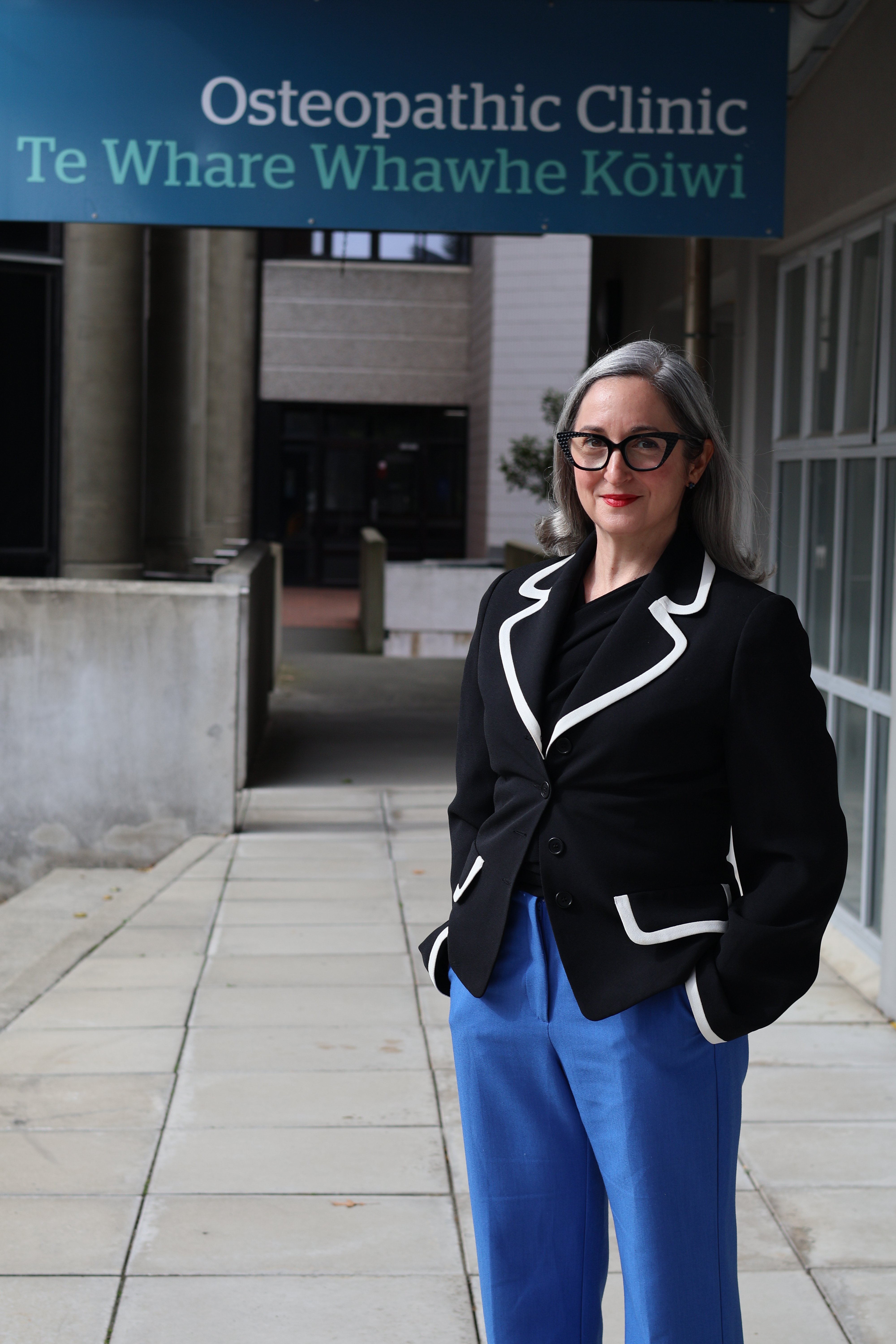
Asking the right questions: Zoe Steele researches what osteopathy can do better
17 April, 2026
How do we know osteopathic care is working?
For Ara osteopathy lecturer Zoe Steele, research starts with a deceptively simple question: how do we know what we're doing is actually helping?
It's a question that has taken her from a published literature review on long COVID to an international collaboration measuring patient outcomes - and into conversations about who currently gets to benefit from osteopathic care, and who doesn't.
Steele joined Ara in 2021, bringing experience in clinical practice and teaching from Adelaide and a Masters from Southern Cross University. Originally from Canada, she came to osteopathy by way of an earlier career in counselling and crisis intervention - a background that sharpened her interest in patient-centred care and in understanding what health outcomes actually look like for real people.
Measuring what matters
Her current research focuses on patient-reported outcome measures (PROMs): tools that capture how patients perceive their own progress before and after treatment. The project runs in collaboration with the United Kingdom National Council for Osteopathic Research (NCOR), which manages the data collection, and began in September 2024. The first dataset is expected soon.
"It's about understanding where patients are at when they come in, and whether what we're doing is actually helping," Steele said.
PROMs offer something that clinical observation alone can't: the patient's own account of change over time. By building this dataset within Ara's osteopathic clinic, Steele is contributing to a stronger evidence base for the profession and connecting local practice to international research.
Long COVID and the limits of what we know
Steele’s interest in supporting people with long COVID grew from a formal mentoring relationship with her Masters supervisor through the Osteopathy Australia mentorship programme. The result was a published literature review examining osteopathic approaches to breathing dysfunction and postural control in long COVID patients.
The work required her to look closely at what the evidence says and to resist the temptation to map a new condition onto existing frameworks.
"When something new comes along, we often try to understand it through what we already know," she said. "But it's important that we keep testing that against the evidence."
One finding that shaped her thinking: long COVID doesn't behave like a cold or flu. Its effects on the body are cumulative, and its main long-term symptoms - breathing difficulties and cardiac issues - are closely linked. That complexity has implications for how osteopaths approach treatment and rehabilitation.
Access, equity and community care
Perhaps the most pressing thread emerging in Steele’s work is access. Osteopathic care in New Zealand sits largely within a private, fee-for-service model. That works for many patients, but it also means a significant portion of the population never engages with it at all.
Steele is exploring what community-based models might look like: how osteopathy might connect with broader primary health networks, with Māori models of health, and with organisations like Te Papa Hauora. This year, Ara established a clinic focused on tamariki (young children), which she described as one of the most meaningful things she's done.
"Who gets access, and who misses out, is something we need to think about more," she said.
Steele sees this community-focused work as a learning opportunity that asks students to think carefully about equity, about whose health is centred, and about where osteopathy fits within a wider health system.
What's next
Steele is currently developing further international research collaborations and continuing work on the PROMs project. She is also contributing to conversations about how osteopathy as a profession can build a stronger, more accessible evidence base that reflects the communities it serves.
She welcomes opportunities to collaborate, share ideas and explore new approaches to patient care.
Connect with Zoe Steele and her mahi
- Breathing retraining and manual therapy for long COVID — A literature review
- NCOR research projects
Ara offers New Zealand's only South Island osteopathy programme. Find out more about studying osteopathy at Ara.