Ara launches refreshed nursing degree built on indigenous foundations
25 March, 2026
Puahou Tapuhi o Aotearoa continues a legacy of leadership in nurse education.

(L-R) Ara’s Nursing Programme Lead, Anna Richardson, former Nursing Portfolio lead Roxanne Will, current Nursing Portfolio lead Allen Hill and Chair of Te Kawa Whakaruruhau rōpū (group) Irihapeti Bullmore mark the beginning of delviery of the new programme.
Ara Institute of Canterbury has welcomed a new cohort of 109 nursing ākonga into its updated Bachelor of Nursing Puahou Tapuhi o Aotearoa - a refreshed qualification to meet the needs of the people nurses serve in Ōtautahi and Te Wai Ponaumu.
Central to the revised three-year curriculum, which meets Nursing Council of New Zealand (NCNZ) requirements, is a strengthened commitment to Te Tiriti o Waitangi and increased indigenised content.
Ara’s Nursing Programme Lead, Anna Richardson, said the work to revise the Bachelor of Nursing began in 2021 and drew on the world views of many people in Aotearoa including clinicians, educators, Māori and Pacific partners and people living with a disability.
Programme development partners the Western Institute of Technology (WITT), led by WITT Head of Nursing, Helen Lelean, will also deliver the new programme from 2027.
“Vast expertise has been drawn on from around the motu to create Puahou Tapuhi o Aotearoa,” Richardson said. “Some of those involved include Sandra McDonald (Ngāti Whātua) and Dr Pipi Barton (Ngāti Hikairo ki Kāwhia) from our sister organisation NorthTech. They’ve been delivering Puawānanga Tapuhi Māori (Bachelor of Nursing - Māori) since the start of 2025.
“Dr Tanya Mullane, Head of Pacific Nursing at Whitireia, and Maureen Kelly from Wintec must also be acknowledged for their immensely valuable input,” she said.
At the heart of the revised programme, approved by the New Zealand Qualifications Authority (NZQA) and the NCNZ panel at the end of 2025, are five mātāpono (core principles) that embed an indigenous lens across the learning.
They include:
· Giving effect to Te Tiriti o Waitangi
· Manaakitanga (care and kindness)
· Aroha (compassion)
· Whanaungatanga (connection)
· Nursing knowledge and work readiness
Richardson said the programme would “equip our nurses to care for a diverse patient population across a range of healthcare settings, while giving effect to our clear obligations under Te Tiriti o Waitangi”.
Speaking to the new cohort gathered for orientation, she said: “You will learn about, or confirm your knowledge of, te ao Māori (the Māori world), including tikanga, customs and traditional values, particularly in Māori contexts.”
She said the material reaffirmed the globally recognised practice of kawa whakaruruhau (cultural safety in a Māori context) and cultural safety, which originated in the pioneering work of Irihapeti Ramsden at Christchurch Polytechnic (now Ara) in the early 1990’s.

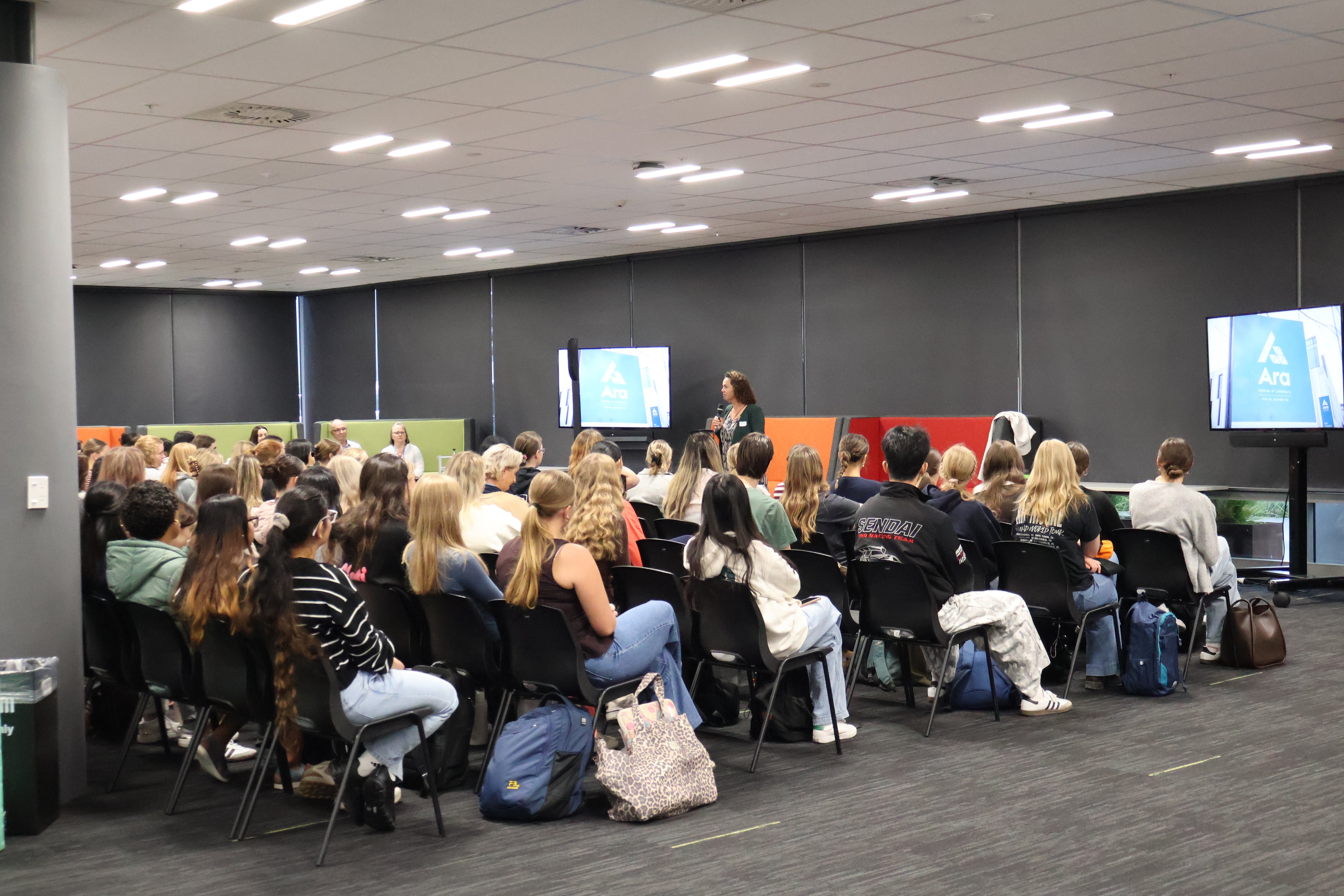
Chair of Te Kawa Whakaruruhau rōpū (group) Irihapeti Bullmore celebrated the programme update
Fittingly, the current lead of Te Kawa Whakaruruhau rōpū (group), Irihapeti Bullmore (Kāi Tahu, Ngāti Kahungunu, Ngāpuhi), was present at Ara’s Manawa campus to welcome the first Puahou Tapuhi o Aotearoa cohort.
“For me, as successor to the chair, it is simply awesome - there is no other word - to see we are still living these principles as a nursing profession,” she said.
“It’s exciting, important and imperative that we recognise nurses must be a well-rounded workforce in Aotearoa, serving the whole community. Indigenised knowledge shows us there is no single way of assessing or responding to need. I would like to recognise Ara’s continued leadership in this space,” she said.
“What we are doing today is further connecting and empowering those of the land in supporting the wellbeing of all. I am honoured to hold this seat and further this legacy as we strive to continue to be global leaders in our field.”
Ara’s Associate Director of Māori Achievement Tate Tiatia said the refreshed programme represents a significant step in achieving the aspirations of kawa whakaruruhau.
“Embedding mātauranga Māori at the heart of this degree isn’t simply an academic choice - it’s an obligation to our communities and to Te Tiriti o Waitangi. When our ākonga learn through an indigenous lens, they gain the cultural confidence and relational skills needed to aim for truly equitable care,” she said.
Ara’s Director - Ako Excellence, Deborah Young, said Ara was delighted to lead the programme review. “We’ve been supported by polytechnics from throughout the country, from the initial concept through to the final Nursing Council panel review.”
“This was a robust process that brought a wide range of voices to the table, informing the work of our quality and educational development teams to ensure learners achieve the best outcomes from a qualification that meets the needs of the NZNC and the sector,” she said.
Richardson said a curriculum embedded in te ao Māori positioned nursing strongly for the future by ensuring the qualification reflected the population nursing serves and encouraged nurses to be lifelong learners.
“We want our graduates to be advocates for equity and justice, making decisions that are sustainable, holistic and evidence-based.
“They will continue to conduct health assessments, to promote optimal outcomes for all consumers across their lifespans.
“Intentionally embracing our legacy from nurse leaders in Aotearoa - Puahou Tapuhi o Aotearoa is a qualification to prepare our ākonga as work ready, proficient communicators and skilled clinicians,” she concluded.

